
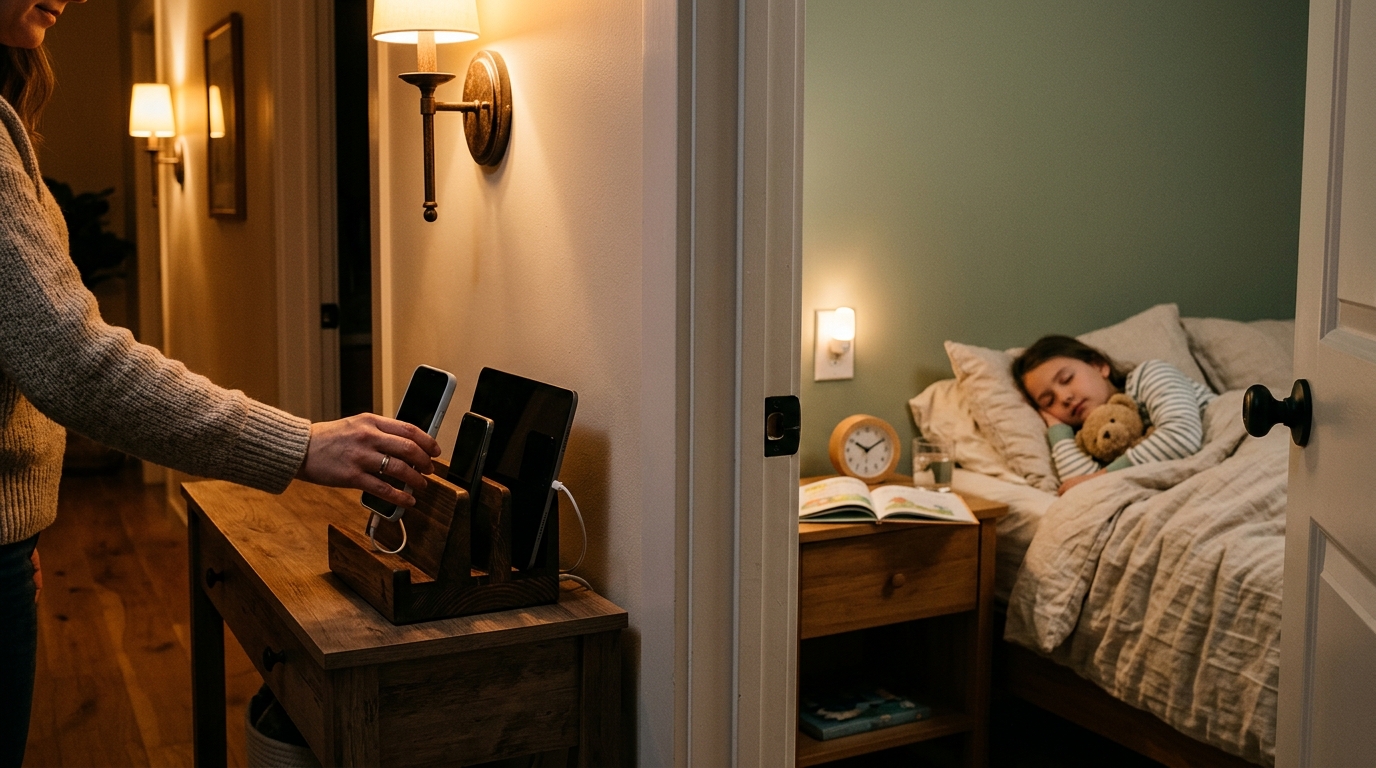
It is 1:30 AM... A faint blue glow illuminates your child's darkened bedroom, accompanied by the muted vibration of a late-night notification. The following morning brings the predictable disaster: tears, exhausted protests of "I can't wake up!", morning chaos, and teachers reporting inability to concentrate. Nighttime phone use among children is recognized by pediatricians as one of today's most pervasive health hazards. Clinical studies from Harvard Medical School and the American Academy of Pediatrics (AAP) demonstrate that evening screen exposure disrupts deep REM sleep in 74% of children and suppresses vital melatonin production by up to 85%. How can families transform bedrooms into screen-free sanctuaries without screaming matches? Here is the complete science-based guide to evening wind-down routines and central charging stations.
What Nighttime Screen Exposure Does to a Developing Brain
Late-night phone usage is not merely poor discipline; it causes direct neurochemical disruption
Melatonin Hormone Suppression
Short-wavelength blue light (450–480 nm) emitted by mobile screens tricks the pineal gland into perceiving bright midday sunshine, delaying sleep-inducing melatonin release by 60 to 90 minutes.
Nocturnal "Vamping" & Micro-Arousals
When phones rest on nightstands, sleeping brains remain in hyper-vigilant low-arousal states. Midnight notifications fragment critical restorative REM sleep cycles.
Dopamine Traps & Cognitive Excitement
Endless social media feeds and interactive gaming trigger rapid dopamine spikes. Opening a video at 11:00 PM revs neural activity into overdrive, eliminating sleepiness.
Academic & Mental Health Fallouts
National Sleep Foundation data confirms sleep-deprived students suffer a 65% increase in classroom inattention, weakened immunity, and double the risk of mood dysregulation.
The 60-Minute Screen-Free Wind-Down Routine
Structure the final hour before lights-out to allow natural melatonin production to peak
Digital Sunset & Device Hand-In
All smartphones, tablets, and gaming consoles power off. Children deposit devices into the central household charging dock in the living room.
Warm Shower & Dimming Household Lights
A warm bath lowers core body temperature upon exit, while dimming bright ceiling lights triggers natural circadian sleepiness.
Paper Books & Quiet Family Connection
Reading a physical paper book, graphic novel, or engaging in a calm bedtime chat with parents without any digital intrusion.
Cool, Dark Bedroom for Deep Rest
In a cool room (65-68°F / 18-20°C) with zero screen glow, children drift into restorative deep sleep within 15 minutes.
The Central Family Charging Station Model
Leaving a charging phone beside a child's bed is an unwinnable battle against dopamine
One Shared Hub in the Living Room
Set up a clean charging dock in the kitchen or living room where every family member—parents included—docks their phone overnight to model healthy digital hygiene.
Gift a Dedicated Analog Alarm Clock
The universal child excuse: "I need my phone in my room as my morning alarm!" Eliminate this objection permanently by buying them an attractive, fun analog desk clock.
Bedrooms as Sleep Sanctuaries
Bedrooms must strictly be for rest and offline reading. Eliminating bedside devices reduces nighttime temptation by 90% instantly.
Lock Nocturnal Access with SmartFamilyEye
Even if a child sneaks to the living room late at night, SmartFamilyEye's automatic Sleep Mode keeps screens locked, leaving only emergency parent calling active.
Nighttime Sleep & Screen Limits by Age Group
Tailor digital curfews to your child's neurological maturity and biological sleep demands
Young children have ultra-sensitive retinas. All screens must shut down 2 hours before bed. Keep bedrooms pitch-black with only soft red-spectrum nightlights if necessary.
Middle-grade students often stretch screen time under the guise of homework. Shut down entertainment apps by 8:30 PM to preserve sleep latency and morning focus.
Teens face intense nighttime peer pressure (FOMO). Enforce automated SmartFamilyEye app lockouts on social feeds and games while permitting offline music or audiobooks.
Eliminate Bedtime Screen Battles with SmartFamilyEye
While you rest peacefully, SmartFamilyEye quietly enforces healthy nighttime digital boundaries on your children’s devices.
Automated Nighttime Sleep Lock
Locks smartphones automatically at your preset bedtime (e.g. 9:30 PM). Entertainment apps shut down while essential emergency calling remains available.
Midnight Tamper & Unlock Alerts
Receive instant silent alerts if a child attempts to unlock their device or adjust system time zones during bedtime hours.
Flexible Weekend Curfew Calendars
Set custom sleep schedules for Friday and Saturday nights, transitioning back to disciplined school schedules automatically on Sunday.
Weekly Sleep Hygiene Reports
Track timestamps between last screen interaction and morning wake-ups to evaluate digital wellness trends with actionable data.
Questions on Night Phone Use & Sleep Routines
❓ My child says "I need my phone to fall asleep to music or podcasts"—what should I do?
Audio can be soothing; the true enemy of sleep is blue light and stimulating interactive video algorithms. You can configure SmartFamilyEye to lock all screens while allowing access exclusively to audio apps like Spotify or audiobooks. Alternatively, place a dedicated standalone Bluetooth speaker in their bedroom while keeping the phone docked in the living room.
❓ Do "Night Mode" and blue light filters make late-night phone use safe?
No. While warm color filters slightly reduce eye fatigue, they solve less than 20% of the problem. The primary driver of insomnia is cognitive arousal triggered by interactive social media feeds, chats, and gaming dopamine loops. An intellectually stimulated brain cannot transition into restorative slow-wave sleep.
❓ My teenager aggressively refuses to hand over their phone at night—how can we resolve this?
Forcibly seizing devices escalates family defiance. Instead, educate them on adolescent biology: "During puberty, melatonin releases 2 hours later, making you feel awake. But screens delay it even further." Agree on a collaborative solution: devices charge in the hallway, weekend hours are flexible, and nighttime app locks are automated via SmartFamilyEye.
❓ How significantly does nocturnal phone use impact school grades and cognitive focus?
Harvard studies demonstrate that losing just 60–90 minutes of nightly sleep reduces child attention spans by 40%, compromises memory retention, and lowers test performance. Reclaiming an uninterrupted 9-hour sleep routine typically produces noticeable academic and emotional improvements within two weeks.