
What Are the Physical Harms of Screen Time on Children?
Slouched spines, red fatigued eyes, and sedentary routines... Explore how excessive phone and tablet use physically impacts children's growing bodies.
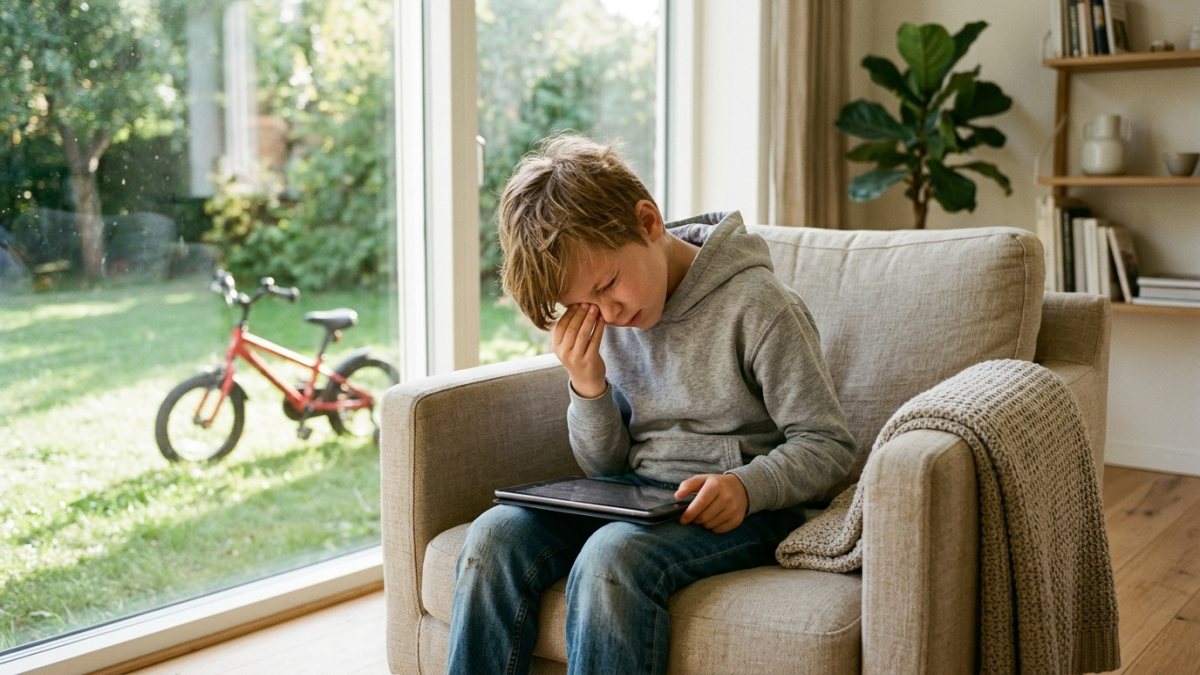
Parents commonly worry about academic slumps and behavioral moods caused by devices. Yet beneath the surface lies an equally urgent medical concern: <strong>the physical harms of excessive screen time on children</strong> leave lasting imprints on immature skeletal frames, eye structures, metabolic rhythms, and restorative sleep cycles. Pediatric orthopedic surgeons and optometrists are increasingly diagnosing chronic conditions—once confined to desk-bound adults—in kids as young as seven. How do <em>tablets physically harm growing bodies</em>, what is the true extent of <em>screen-induced eye damage in children</em>, and exactly <em>how many hours a day should children use screens?</em> In this medical guide, we investigate text neck, early myopia, childhood obesity, and actionable protective habits.
Text Neck Syndrome and Postural Misalignment in Children
Every 15-degree forward tilt multiplies the gravitational load on fragile cervical vertebrae.
In an upright posture, an average human head exerts approximately 10 to 12 pounds of force on neck muscles. But when a child bends forward at a 60-degree angle to play a tablet game, the effective weight on their cervical spine jumps to an astonishing 60 pounds (27 kg)! In bodies whose cartilage and ligament tensile strength are still developing, this sustained load accelerates cervical disc degeneration, early kyphosis (hunchback posture), and chronic thoracic muscle spasms.
Spinal Kyphosis & Chronic Back Aches
Hours spent curled in a tight "C-shape" over tablets overstretch back musculature and deform spinal curves.
Thoracic Compression & Shallow Breathing
Caved-in shoulders restrict thoracic expansion, reducing oxygen uptake and causing daytime lethargy.
Nerve Impingement & Mobile Tendonitis
Continuous thumb scrolling and awkward grip angles lead to repetitive strain injuries and juvenile carpal compression.
Screen Damage to Children’s Vision: Digital Strain & Pediatric Myopia
Blink rates plunge by 60%, escalating dry eye syndrome and progressive nearsightedness.
Under normal conditions, a person blinks 15 to 20 times per minute to refresh the corneal tear film. When fixating on a bright digital display, a child's blink rate drops to just 4 to 5 times per minute, triggering corneal dryness, burning sensations, and chronic eye rubbing. Crucially, sustained close-up accommodation combined with insufficient natural daylight causes eyeball axial elongation, accelerating juvenile myopia.
Sleep Fragmentation, Sedentary Habits, and Obesity Risks
Prolonged screen exposure suppresses nocturnal melatonin and disrupts essential growth hormones.
Complete Melatonin Suppression
High-energy short-wavelength blue light tricks the pineal gland into perceiving bright daylight. Melatonin release is delayed by hours, depriving children of restorative deep REM sleep.
Hypo-Activity and Metabolic Slowdown
Hours spent stationary on couches dramatically decrease basal calorie expenditure. Mindless snacking while watching videos triples the statistical risk of childhood obesity.
Weakened Immune Resilience
Without sound sleep and adequate outdoor vitamin D exposure, natural killer cell production drops, leaving kids vulnerable to recurring seasonal illnesses.
How Many Hours a Day Should Children Use Phones?
World Health Organization (WHO) and American Academy of Pediatrics (AAP) official recommendations.
| Age Category | Maximum Daily Screen Allowance | Content Requirement | Daily Physical Activity Target |
|---|---|---|---|
| 0 - 2 Years | Zero Screen Time | Interactive family video calls only | At least 30 min of floor play / tummy time |
| 2 - 5 Years | Max 1 Hour / Day | High-quality educational co-viewing with parents | At least 180 min of active physical movement |
| 6 - 12 Years | 45 - 60 Minutes / Day | Recreation strictly after homework; non-violent | At least 60 min of moderate-to-vigorous sport |
| 13+ Years (Teens) | Max 1.5 - 2 Hours / Day | Social filters enabled; screens off before sleep | At least 60 min of daily outdoor / athletic activity |
5 Golden Rules to Shield Your Child’s Physical Health
Easy-to-implement ergonomic and lifestyle safeguards for every home.
Enforce the 20-20-20 Eye Routine
Every 20 minutes of screen use, instruct your child to gaze at an object 20 feet (6 meters) away for 20 seconds to reset ciliary eye muscles.
Maintain a 16-Inch Eye Distance
Never let devices touch their face. Enforce an elbow-to-hand distance benchmark.
Prohibit Prone (Stomach) Screen Use
Lying flat on the stomach while propping up on elbows severely arches the lumbar and cervical spine. Always insist on upright seated posture.
Establish a 60-Minute Pre-Bed Digital Curfew
Ban screens in bedrooms overnight. Charge all family devices in a common charging station outside sleeping quarters.
Automate Posture Breaks with SmartFamilyEye
Program periodic 10-minute activity pauses every half hour to prompt physical stretching and hydration.
Complementary Reading for Healthy Childhoods
Child Phone Addiction: Psychological Signs and Harms
Analyze dopamine cycles, sudden tantrums during screen confiscation, and social withdrawal.
How to Control Child Screen Time: 7 Proven Methods
Actionable strategies for setting family digital contracts, reward routines, and SmartFamilyEye limits.
Frequently Asked Questions
Can prolonged screen time permanently damage a child’s vision?
Yes. Extended close-up focal strain without natural outdoor sunlight physically elongates the ocular globe, dramatically raising the risk of high progressive myopia.
Is "Text Neck" irreversible in growing children?
If caught early, corrective ergonomic habits and posture exercises can reverse muscular strain. However, chronic uncorrected slouching can induce permanent spinal remodeling.
Does night screen use impair physical growth in children?
Yes. Up to 80% of human growth hormone (HGH) is released during slow-wave deep sleep. Blue light delays sleep onset and disrupts peak nocturnal growth hormone secretion.
Do blue-light blocking glasses solve the entire problem?
No. While they filter certain glare wavelengths, they do not resolve the 60% drop in blink rates, eye fatigue, sedentary physical harm, or spinal text neck.
How does SmartFamilyEye protect physical health?
SmartFamilyEye enforces automated night sleep locks to safeguard melatonin production and imposes daily time ceilings to prevent endless sedentary couch-sitting.
Protect Your Child from Physical Screen Fatigue
Set healthy boundaries, posture breaks, and automatic bedtime locks with SmartFamilyEye. 14 days free full trial.